
Successful investing is not just about picking winning stocks. It is equally about avoiding mistakes that can steadily erode wealth. Many retail investors lose money not because markets are difficult, but because emotions, poor risk management and impulsive decisions take over.
From over-trading and ignoring stop-losses to chasing market trends and acting on random “tips”, small errors can quickly turn into costly lessons. In investing, protecting capital is just as important as generating returns.
According to INVasset PMS's Harshal Dasani, the mistakes that hurt portfolios the most are often structural rather than emotional.
“One of the biggest mistakes investors make is trading without understanding the broader market cycle. If you do not know whether earnings are accelerating or slowing, or whether liquidity conditions are improving or tightening, you end up reacting to price movements instead of positioning ahead of them,” he said.
Dasani also warned investors against mistaking momentum for conviction. Stocks that have already rallied sharply may no longer offer attractive risk-reward opportunities, as many investors tend to enter when optimism is at its peak.
He added that ignoring sector rotation is another common error.
“Capital moves in cycles. Staying attached to last year’s outperformers while new opportunities emerge elsewhere can prove expensive,” he noted.
On portfolio construction, Dasani said position sizing should reflect conviction and probability, not emotional comfort. He also cautioned against blindly averaging down on falling stocks without reassessing the original investment thesis or changing macroeconomic conditions.
“The solution is not discipline in the abstract, but a rules-based framework that removes bias from decision-making,” he said.
He advised investors to define entry and exit criteria in advance, track data instead of reacting purely to price action, size positions appropriately and regularly review investment assumptions.
“The market rewards preparation and punishes hope,” he added.
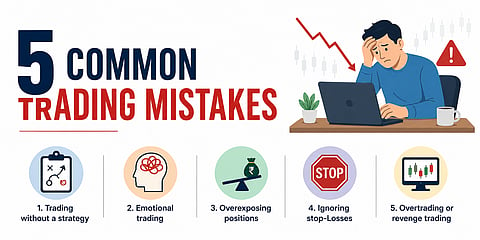
Many beginners enter trades based on tips, social media chatter or sudden market moves without having a clear plan. Buying a stock simply because it is “trending” often leads to emotional decisions.
Investors should develop a clear strategy with defined targets, stop-loss levels and position sizing before entering a trade.
Fear and greed often influence trading decisions. Investors may hold on to loss-making positions for too long or exit profitable trades too early.
Panic selling after a small correction or refusing to book losses in the hope of a rebound can hurt long-term returns.
Maintaining a trading journal and following strict stop-loss rules can help reduce emotional decision-making.
Taking oversized bets or using excessive leverage can magnify losses quickly. Allocating a large portion of capital to a single trade can severely damage a portfolio if markets move unfavourably.
Experts generally recommend risking only 1-2 percent of total capital on a single trade.
Small losses can turn into major setbacks when investors refuse to exit losing trades. Continuously lowering stop-loss levels in the hope of a recovery often leads to deeper losses.
Investors should always place stop-losses at sensible support levels and follow them strictly.
After suffering losses, many traders attempt to recover quickly through frequent impulsive trades. This usually results in even bigger losses and rising stress.
Investors should focus only on high-probability opportunities and avoid emotional trading after a losing streak.

