
Indian stock markets are heading into a holiday-shortened trading week with the Nifty 50 approaching the crucial 26,000 mark, supported by strong foreign institutional investor (FII) inflows and a sharp rally in banking stocks. (NSE and BSE closed for Guru Nanak Jayanti on November 24.)
However, profit-booking after the recent gains, volatility surrounding the November derivatives expiry and global economic developments could test the market's momentum.
The Sensex ended the week on November 20 at 83,920, gaining 2.9%, while the Nifty 50 advanced 2.6% to close at 25,801. The recovery was particularly strong during the final two trading sessions, helping Indian equities outperform several global markets.
Foreign investment, a strengthening rupee and softer crude oil prices provided support, although weakness in information technology and metal stocks remained a concern.
Foreign institutional investors have emerged as a major driving force behind the market recovery. Net FII purchases reached ₹1,11,949 crore in November through November 20, marking an exceptionally strong month for foreign investment in Indian equities.
Domestic institutional investors (DIIs), meanwhile, recorded net sales of approximately ₹61,786 crore during the same period.
The rupee also strengthened by around 1.6% against the US dollar during the week, supporting investor sentiment.
Indian markets have significantly outperformed their global counterparts so far in November. The Sensex and Nifty have gained 12.71% and 11.92%, respectively, while major Asian, American and European indices have suffered substantial losses.
The immediate challenge for the Nifty 50 is to sustain its upward momentum and cross the psychological resistance level of 26,000. A decisive breakout above this level could open the possibility of a further advance towards 26,341, the previous record-high zone.
Banking, financial services and automobile stocks are expected to remain important drivers of the rally. Realty stocks could also attract buying interest if the positive momentum continues.
However, selective buying may be preferable to aggressive investment following the recent gains. Global uncertainties could continue to weigh on technology and metal stocks.
Banking stocks were the standout performers during the previous week. The Nifty Bank index surged 5.9%, touching a fresh record high of 64,681 before settling at 64,635.
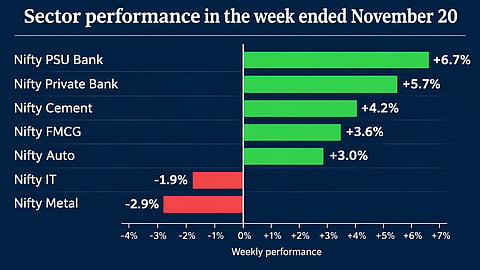
Public sector banks outperformed private lenders, with the Nifty PSU Bank index gaining 6.7%, compared with a 5.7% rise in Nifty Private Bank.
Among individual stocks, IDFC First Bank and IndusInd Bank gained 9.7% each. Punjab National Bank rose 8.8%, Axis Bank 8.6%, State Bank of India 7.9% and Union Bank of India 7.8%.
The next important level for Nifty Bank is 64,800. Sustained trading above this level could potentially push the index towards 66,200.
However, the sharp rally also raises the possibility of profit-booking, particularly in stocks that have already registered substantial gains.
Beyond banking, cement, FMCG and automobile stocks recorded healthy gains during the week.
Nifty PSU Bank: +6.7%
Nifty Private Bank: +5.7%
Nifty Cement: +4.2%
Nifty FMCG: +3.6%
Nifty Auto: +3.0%
Nifty IT: -1.9%
Nifty Metal: -2.9%
Healthcare stocks also attracted buying interest, with Max Healthcare gaining 14% and Apollo Hospitals advancing 7.9%.
In contrast, metal, IT, defence and capital-market stocks faced selling pressure.
Investors may continue rotating funds towards sectors showing stronger earnings prospects and price momentum rather than buying across the market indiscriminately.
Investors will also position themselves ahead of India's second-quarter FY27 GDP figures, scheduled for November 30. The data will provide fresh indications of domestic economic growth.
The OPEC+ meeting on November 29 could influence crude oil prices, an important factor for India because of its dependence on imported petroleum.
For the coming week, 26,000 remains the key level to watch on the Nifty, while 64,800 will be important for the banking index. Continued foreign inflows and broader sector participation could support further gains, but investors should remain alert to profit-booking and global volatility.
