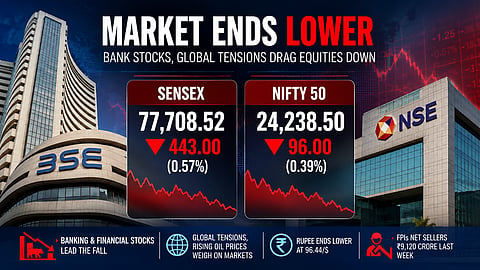

Heavy selling in banking shares, rising geopolitical tensions in West Asia and persistent foreign investor outflows weighed on Indian equities on Monday, even as mid cap and small cap stocks outperformed the benchmark indices.
The Sensex dropped 443 points (0.57 percent) to close at 77,708.52, while the Nifty 50 lost 96 points (0.39 percent) to end at 24,238.50. In contrast, the Nifty Midcap 100 gained 0.60 percent and the Nifty Smallcap 100 added 0.16 percent, reflecting continued buying interest in the broader market.
Although the Nifty ended in negative territory, 36 of its 50 constituent stocks closed higher. Trent, Power Grid and Nestlé India were among the top gainers, while Axis Bank, HDFC Bank and Maruti Suzuki led the declines.
The biggest drag on the market came from banking and financial stocks after investors reacted negatively to the latest quarterly earnings from major lenders.
Axis Bank tumbled 5.38 percent, HDFC Bank fell around 5 percent and Kotak Mahindra Bank lost more than 2 percent. The Bank Nifty declined 1 percent, while the Nifty Financial Services index dropped 1.2 percent.
Investors remained concerned that net interest margins could remain under pressure in the coming quarters, particularly if rising crude oil prices lead to higher inflation and tighter monetary policy.
Investor confidence was also dented by escalating tensions between the US and Iran, which have heightened fears of prolonged geopolitical instability.
Global markets remained cautious:
South Korea's Kospi fell sharply
European markets traded mixed
Investors shifted towards safer assets amid rising uncertainty
The continuing conflict has increased concerns about its potential impact on global growth and inflation.
Although Brent crude eased slightly during the session, it continued to trade close to the 88-dollar-a-barrel mark after touching its highest level in more than a month.
Higher crude prices are a major concern for India because:
India imports most of its crude oil requirements
Costlier oil can push up inflation
It may widen the current account deficit
It could reduce room for interest rate cuts
Higher energy prices also tend to weigh on corporate profitability across several sectors.
The Indian rupee closed 14 paise lower at 96.44 against the US dollar.
A weaker currency raises import costs, particularly for crude oil, and can discourage foreign investment. Market participants fear that continued geopolitical tensions and elevated oil prices could keep pressure on the rupee.
Foreign portfolio investors (FPIs) remained net sellers in the cash market, having sold equities worth ₹9,120 crore during the previous trading week.
Persistent FPI selling has become another headwind for domestic markets, particularly for sectors such as banking and information technology, where overseas investors hold significant positions.
Despite weakness in benchmark indices, broader markets continued to display relative strength.
Nifty Midcap 100 gained 0.60 percent
Nifty Smallcap 100 rose 0.16 percent
Buying interest remained visible in select consumption, infrastructure and utility stocks
The resilience of broader markets indicates that investors are selectively accumulating stocks despite near-term global uncertainties.
According to technical analysts, the immediate resistance for the Nifty lies in the 24,370-24,400 zone. A sustained move above this range could open the way towards 24,550 and later 24,700.
On the downside, immediate support is placed in the 24,130-24,100 range. A breach below these levels could lead to further weakness in the short term.
Sensex: 77,708.52 (-443 points)
Nifty 50: 24,238.50 (-96 points)
Nifty Midcap 100: +0.60 percent
Nifty Smallcap 100: +0.16 percent
Bank Nifty: -1.00 percent
Nifty Financial Services: -1.20 percent
Rupee: 96.44 per US dollar
Brent crude: Near $88 a barrel

