
Indian equity markets ended sharply lower on Monday, November 23, as heavy selling in banking, financial services and metal stocks dragged benchmark indices into the red. Profit booking after a four-week rally, weak global cues and volatility linked to derivatives expiry weighed on investor sentiment.
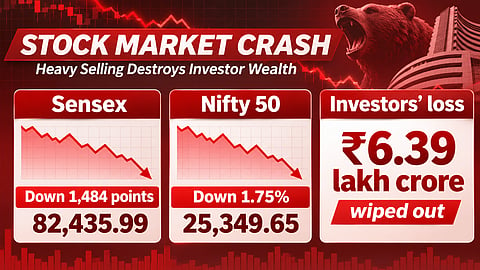
The BSE Sensex plunged 1,484 points, or 1.77%, to 82,435.99, while the NSE Nifty 50 declined 1.75% to 25,349.65, reversing early gains. The sell-off erased more than ₹6.39 lakh crore in investor wealth, reducing the combined market capitalisation of BSE-listed companies to around ₹508 lakh crore.
Selling pressure was widespread, although information technology and realty stocks offered some support.
Sensex: Fell 1,484 points to 82,435.99.
Nifty 50: Declined 1.75% to 25,349.65.
Investor losses: More than ₹6.39 lakh crore wiped out.
Metals: Sectoral index dropped 3.7%.
Broader markets: Smallcap and Midcap indices fell 0.7% and 1%, respectively.
Sectoral performance: IT and realty bucked the broader weakness.
Profit booking after strong rally
Profit booking emerged as a major reason for Monday's decline. Indian equities had recorded substantial gains over the previous four weeks, supported by foreign institutional investor inflows.
The Nifty had gained around 10% in November, prompting investors to book profits at higher levels. Banking and financial services stocks, which had rallied sharply in recent weeks, faced particularly heavy selling.
Banking heavyweights drag indices
Selling in heavyweight stocks, including HDFC Bank, ICICI Bank, State Bank of India and Axis Bank, added pressure on benchmark indices. HDFC Bank and ICICI Bank declined around 3.3% each, while Reliance Industries shed approximately 1.9%.
Metal stocks were among the biggest losers, affected by weaker commodity prices and a stronger US dollar.
Weakness in global equity markets further dampened sentiment. Asian markets traded lower, with South Korea's Kospi falling sharply amid selling in technology heavyweights, including Samsung Electronics and SK Hynix.
The decline followed a steep correction on Wall Street in the previous session. The S&P 500 fell 3.7%, while the Nasdaq Composite plunged 5.28% and the Dow Jones declined 1.93%.
Concerns over elevated valuations of artificial intelligence-related technology companies contributed to the global sell-off.
Uncertainty surrounding the US Federal Reserve's interest-rate outlook also weighed on investor confidence. Concerns over persistent US inflation and the possibility of prolonged monetary tightening affected global risk appetite.
Volatility ahead of derivatives expiry intensified selling pressure in Indian markets.
The rupee weakened against the US dollar after five consecutive sessions of gains. However, Brent crude prices below $92 a barrel offered some support.
Market participants will now closely watch foreign investor flows, global market trends and the US Federal Reserve's policy signals for further direction.
