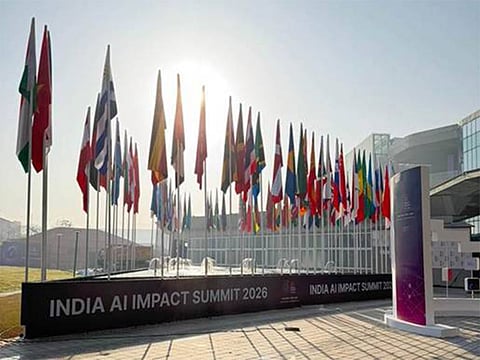

As global anxiety over artificial intelligence deepens, the centre of gravity has briefly shifted from Silicon Valley and Brussels to New Delhi. The AI Impact Summit 2026, now under way in India’s capital, brings together tech chiefs, policymakers and researchers at a time when questions over safety, governance and fairness are growing louder — even as commercial competition accelerates.
Unlike last year’s gathering in Paris, which exposed sharp rivalries among Western powers, this year’s summit is being hosted in the Global South. That shift is more than symbolic. It reflects a growing recognition that the future of AI will not be shaped solely by the US and Europe — and that countries such as India have both stakes and grievances in how the technology evolves.
At the previous AI Action Summit in France, geopolitical tensions overshadowed cooperation. Western leaders jostled for influence, and the US delegation forcefully underlined America’s dominance in AI development. In contrast, Delhi’s summit is expected to carry a more measured tone — at least in public.
India occupies a complex position in the AI ecosystem. It has been instrumental in building the global technology backbone that supports AI systems, yet it captures only a fraction of the economic rewards enjoyed by companies in the US and China.
Cities such as Bengaluru, Hyderabad and Mumbai have emerged as AI hubs, attracting investments from global giants including Google, Nvidia and Amazon. India also has one of the world’s largest technology workforces.
At the same time, thousands of low-paid workers undertake the painstaking task of labelling and moderating the data that trains AI systems — a largely invisible but critical function. According to recruitment platform estimates, the average annual salary of an AI data trainer in Chennai is about ₹4.8 lakh, underscoring the stark gap between labour costs and the soaring valuations of global AI firms.
The 2026 International AI Safety Report highlights a widening adoption gap. In some advanced economies, more than half the population uses AI tools. Across much of Africa, Asia and Latin America, adoption rates are estimated to remain below 10 percent.
India illustrates the structural challenges. The world’s leading US chatbots do not yet function across all of India’s 22 official languages, let alone the hundreds of dialects spoken nationwide. While systems such as ChatGPT and Anthropic’s Claude support several Indian languages, coverage remains partial. Google’s Gemini currently supports only a limited set.
Without language inclusion, experts warn, millions risk being excluded from AI-driven advances in education, healthcare, governance and financial services.
The summit’s stated ambition is to move towards a more inclusive, bottom-up framework for AI governance — one that prioritises people, planet and equitable progress rather than pure technological dominance. But scepticism remains.
Some experts argue that meaningful impact will require greater transparency from AI companies, particularly around training data, model architecture and testing practices. Others fear that safety and accountability may receive limited concrete attention in Delhi.
There is also debate over whether India can play the role of bridge-builder between advanced economies and the Global South. As one of the world’s largest emerging powers, it has both the scale and the diplomatic leverage to push for more democratic AI governance — but must balance that against its own economic ambitions.
For India, AI is not merely a technology race; it is tied to economic transformation, digital sovereignty and job creation. Policymakers are keen to harness AI to boost productivity, strengthen public service delivery and support domestic innovation.
The question hanging over the Delhi summit is whether it can move beyond rhetoric. Will the world’s technology leaders temper their dominance and share more responsibility? Can developing nations secure fairer access to AI tools and infrastructure? And crucially, will safety regain its central place in global AI discussions?
As AI’s commercial power surges, expectations from this summit remain cautious. Yet the fact that the conversation has shifted to India signals a broader truth: the future of artificial intelligence will not be decided in Silicon Valley alone.
