
Imagine arriving at work and discovering that your emails are inaccessible, online meetings cannot begin and important business documents will not open. Now imagine the same problem affecting hundreds of thousands of offices, enterprises and organizations across different countries simultaneously.
This is what a major technology outage can look like. The disruption to Microsoft's cloud services, which began on November 12, offers another reminder of how deeply businesses and public services depend on digital infrastructure controlled by a relatively small number of companies.
Microsoft, Amazon, Google and other technology providers power much of the infrastructure behind everyday digital services. When their systems experience technical failures, the consequences can extend far beyond their own customers.
Recent outages have disrupted financial transactions, airline operations, hospital systems and business communications. More importantly, they have raised a fundamental question: has the world become too dependent on a few technology platforms?
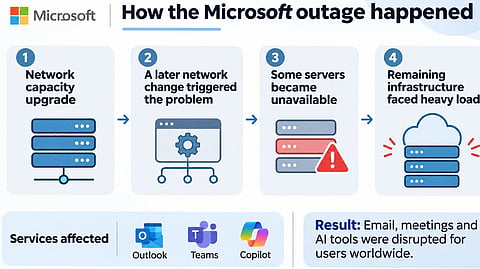
Microsoft's latest disruption affected Microsoft 365 services, including Outlook, Teams and Copilot. Users across several countries reported difficulties accessing emails, calendars and other cloud-based applications.
The outage began on November 12 and lasted more than 24 hours. Microsoft subsequently confirmed that services had been restored. According to Microsoft's preliminary findings, a problem introduced during an earlier network capacity upgrade emerged after another network change. Servers became unavailable, increasing the load on the remaining infrastructure.
The company said the incident was technical and unrelated to a cyberattack or artificial intelligence systems.
The disruption affected businesses, government services and financial institutions. Some organizations had to rely on alternative communication methods while their regular systems remained inaccessible.
One of the most damaging technology failures occurred on July 19, 2024, when an update from cybersecurity company CrowdStrike caused approximately 8.5 million Windows devices to malfunction.
Computers displayed the notorious Blue Screen of Death, an error screen indicating that Windows had encountered a serious problem. The problem originated in a faulty update to CrowdStrike's Falcon security software, which is installed on computers to detect cyber threats. Instead of protecting the affected systems, the update caused them to crash.
Airlines cancelled flights, airports experienced delays, hospitals faced operational difficulties and businesses struggled to restore their computers.
The incident demonstrated how a mistake in a single software update could disrupt millions of devices across unrelated industries.
On October 4, 2021, Facebook, Instagram and WhatsApp became inaccessible worldwide for nearly six hours. The outage originated from a configuration change affecting Meta's internal network.
In simple terms, the systems responsible for directing internet traffic lost the information needed to connect users to Meta's servers. The disruption affected individuals and businesses that depended on WhatsApp for customer communication, online orders and routine transactions.
Meta later confirmed that the failure resulted from an internal configuration error rather than malicious activity.
On October 20, 2025, Amazon Web Services (AWS) suffered a major disruption involving its US-East-1 cloud region. AWS provides computing infrastructure to companies that prefer renting server capacity rather than operating their own data centres.
The incident began with a failure in the system responsible for directing requests to Amazon's DynamoDB database service. A software defect caused an incorrect DNS record, making the service temporarily difficult to reach. The resulting problems spread to other AWS services.
The disruption affected applications and businesses dependent on the region, with the wider incident lasting roughly 14.5 hours.
Google experienced another major outage on June 12, 2025, affecting cloud services and applications including Gmail, Google Drive, Calendar and Meet.
The problem originated from a faulty change affecting Google's cloud infrastructure. A critical service repeatedly crashed, causing widespread failures in applications that depended on it.
Google reported that the main global incident lasted approximately three hours, although recovery times varied across services. The outage highlighted how failures in shared infrastructure can affect several seemingly independent products simultaneously.
The common factor behind these incidents is the growing concentration of digital infrastructure. Businesses increasingly rely on cloud computing, which allows them to store data, operate software and manage digital services through remote servers.
This reduces the cost of maintaining physical infrastructure and makes technology more accessible.
However, it also creates dependencies. A bank, hospital, airline and online retailer may use completely different applications while depending on the same cloud provider. If that provider experiences a major disruption, all four organisations could face problems simultaneously.
India's expanding digital economy makes these risks particularly relevant. IT companies, banks, startups, hospitals and exporters increasingly depend on international technology platforms.
IT companies and small businesses also rely on cloud-based email, accounting, customer management and communication systems. An overseas infrastructure failure could therefore disrupt operations in Kochi or Thiruvananthapuram, even when local internet connections remain functional.
For smaller businesses, the consequences can include delayed orders, interrupted payments, lost productivity and dissatisfied customers.
Completely eliminating technology outages is unrealistic. However, organisations can reduce their exposure.
Maintaining regular offline backups, alternative communication channels and emergency operating procedures can help essential activities continue during disruptions.
Larger organisations may also distribute critical workloads across different locations or technology providers. Such arrangements involve additional costs and complexity, making it important to identify which operations genuinely require greater protection.
The bigger lesson from the Microsoft, CrowdStrike, AWS, Google and Meta incidents is that technological convenience comes with operational risks.
As more economic activity moves online, digital reliability is becoming as important to business continuity as electricity, transport and telecommunications.
The challenge for companies is no longer simply adopting new technology. It is ensuring that their businesses can continue functioning when that technology unexpectedly fails.
