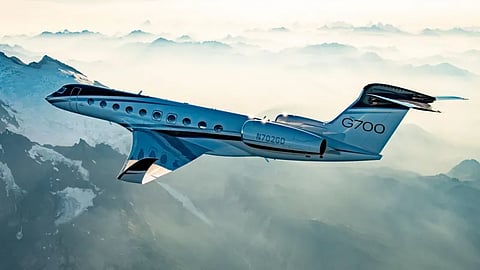

At the far end of the Singapore Airshow, away from roaring fighter jets and packed commercial airliners, a quieter but no less intense contest is under way. Aircraft makers are vying for the attention of Asia’s fastest-growing class of ultra-wealthy travellers, unveiling private jets that resemble flying penthouses more than planes.
Long queues under the tropical sun formed outside Gulfstream’s G700, one of the most talked-about business jets at Asia’s largest aviation and defence exhibition. With its sweeping wings, wide oval windows and minimalist design, the aircraft is a visual statement of where private aviation is headed. Step inside and the message becomes clearer: this is about space, speed and comfort, tailored for a select few who can afford to spend tens of millions of dollars on a single aircraft.
Inside the G700, light pours through near-panoramic windows onto pale leather seats and polished wood finishes. Gulfstream describes the layout not in rows or cabins, but as “living areas”, including a lounge, a media zone and, at the rear, a bedroom suite complete with a shower. Sales discussions continue quietly onboard as potential buyers weigh both price and purpose.
This focus on a narrow but wealthy customer base reflects a broader shift in aviation. While commercial airlines chase scale and passenger volumes, private jet manufacturers are targeting corporations and individuals who value time and flexibility over cost. According to aviation intelligence firm WingX, global private jet flights touched about 3.7 million in 2025, up 5 percent from the previous year and around 35 percent higher than pre-pandemic levels. Over the same period, the global population of ultra-high-net-worth individuals, those worth more than $30 million, rose by over 70 percent.
Gulfstream is not alone in this race. Dassault Aviation, Bombardier, Embraer and Textron Aviation are all pushing new or upgraded models, betting that demand for premium, point-to-point travel will keep rising. For manufacturers, the economics are attractive. Airlines typically operate on thin margins of 2 percent to 4 percent, while private jets sell in small volumes at high prices, with steady revenue from maintenance, parts and long-term service contracts.
Dassault, best known for its military aircraft, says technology from its fighter jets feeds directly into its Falcon business aircraft. The company argues that buyers are driven less by luxury and more by efficiency. Executives say frequent travellers can sometimes spend less over time than repeated first-class travel, especially when factoring in time saved by avoiding connections and crowded hubs.
Reducing fatigue has become a key selling point. Newer jets promise lower cabin noise, better air quality and cabin pressure closer to ground levels, helping passengers arrive less tired after long flights. This emphasis on well-being is particularly attractive to senior executives and business owners who travel frequently across continents.
Asia is central to this growth story. International air traffic in the Asia-Pacific region grew 8 percent in 2025, outpacing global averages. Manufacturers report rising interest from South East Asia, Australia and India, where growing wealth and expanding global business ties are fuelling demand. Smaller business jets are also well suited to countries such as Indonesia and the Philippines, where many airports have shorter runways.
China, once Asia’s largest private jet market, has cooled in recent years, but manufacturers expect a rebound as Chinese companies expand overseas and seek faster, more direct travel options.
The trend is not without criticism. Environmental concerns loom large, as private jets are among the most carbon-intensive modes of travel.
As Asia’s super-rich continue to grow in number and influence, the battle for the skies above them is intensifying. For plane makers, luxury is no longer just an indulgence. It is a business strategy.

