
India’s aviation sector is facing a fresh crisis as the escalating conflict involving the US, Israel and Iran disrupts key air routes, drives up fuel costs and weakens the rupee. With large parts of West Asian airspace shut and crude prices rising sharply, airlines are grappling with mounting operational costs and flight disruptions. Industry estimates suggest the sector could face losses of around ₹17,000–18,000 in FY2026 if the disruption persists.
The war escalated after US and Israeli strikes killed Iran’s Supreme Leader Ayatollah Ali Khamenei on February 28, triggering missile and drone attacks by Iran on Israel and US bases across the Gulf. In response, several countries shut their airspace, including Iran, Iraq, the UAE, Saudi Arabia, Qatar, Bahrain and Kuwait.
These closures severed a crucial aviation corridor for India, as nearly 50 percent of the country’s international air traffic passes through West Asia.
Between February 28 and March 2, more than 1,100 flights were cancelled. At Delhi’s Indira Gandhi International Airport alone, about 350–410 flights were disrupted daily. Airports in Mumbai and other cities also reported significant delays and cancellations.
While aviation activity in the Gulf came almost to a standstill initially, some flights to Europe have gradually resumed by avoiding conflict-affected airspace.
Indian airlines are facing a double setback.
Northern routes remain restricted due to Pakistan’s airspace closure.
Middle Eastern routes have become risky due to the ongoing conflict.
As a result, flights to Europe and the US are being rerouted, adding between two and four hours to journey times and increasing operating costs.
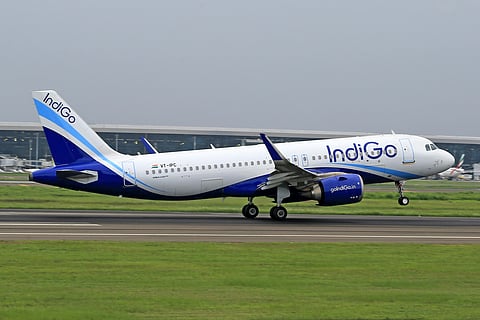
Air India has resumed some services, but IndiGo faces additional constraints because several of its long-haul flights use damp-leased Dreamliner aircraft from European carrier Norse Atlantic. These aircraft fall under European regulatory oversight, forcing the airline to adopt a more cautious approach.
Aviation Turbine Fuel (ATF) is the largest expense for Indian airlines, accounting for 30–40 percent of total operating costs.
Crude prices have surged amid fears that the conflict could disrupt supplies through the Strait of Hormuz. Even before the latest escalation, ATF prices had already risen sharply.
ATF prices for March 2026 stood at ₹96,638 per kilolitre, about 6 percent higher than in February and far above the pre-Covid level of ₹64,715.
For airlines, even small increases can have a large impact. Industry estimates suggest that a $1 per barrel rise in ATF prices can add around ₹300 crore to IndiGo’s annual fuel bill. Longer flight paths due to rerouting further increase fuel consumption, while limited hedging leaves most Indian airlines exposed to spot price fluctuations.
The sharp depreciation of the rupee is adding another layer of financial stress.
The currency slipped past ₹92 against the dollar for the first time on March 4, falling 0.9 percent that day and more than 2 percent so far this year. Rising oil import costs, war-related uncertainty and foreign fund outflows have all contributed to the slide.
For airlines, this has a direct impact because several key expenses are denominated in dollars.
Aircraft leases are largely dollar-based.
Fuel purchases are linked to global prices.
Pre-delivery payments for new aircraft orders are also made in foreign currency.
Industry estimates suggest that a 1 percent fall in the rupee can reduce airline profitability by about 5–6 percent.
Credit rating agency ICRA had earlier projected that the Indian aviation industry’s net loss would widen to ₹170–180 billion in FY2026, up sharply from an estimated ₹5,500 in FY2025. Losses were expected to narrow to ₹11,000–12,000 by FY2027.
However, these projections did not factor in the current geopolitical crisis and the surge in oil prices, meaning the outlook may deteriorate further if the conflict continues.
Airlines such as SpiceJet, Air India Express and Akasa Air have a significant portion of their capacity deployed on Middle East routes, making them particularly vulnerable to the disruption. Air India, with a broader international network, may be relatively better placed but is still affected by airspace restrictions.
Airlines are also dealing with the challenge of stranded passengers. Many travellers have been left midway through journeys or unable to return home due to cancellations and limited flight availability. In some cases, passengers risk overstaying visas because they cannot secure return flights.
The government has set up a passenger assistance control room, but the closure of multiple airspaces has limited the ability to add flights or organise evacuation operations.
With only limited routes currently operational and the conflict showing no signs of immediate resolution, Indian airlines remain on high alert.
For the aviation sector, already struggling with high costs and tight margins, the West Asia conflict could become one of the most severe shocks in recent years unless a ceasefire or diplomatic breakthrough emerges soon.

