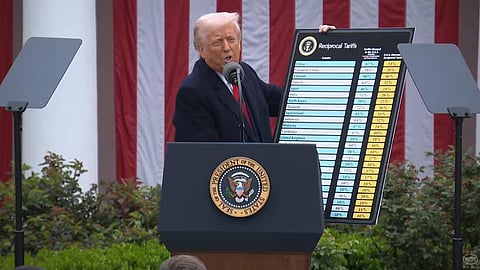

US President Donald Trump, on December 9, made waves with remarks that his administration may soon impose new tariffs on agricultural imports, focusing on Indian rice and fertiliser sourced from Canada. The comments came during a meeting at the White House, alongside the announcement of a USD 12 billion support package for American farmers struggling with increasing economic pressures.
Trump's remarks highlight the escalating frustration within his administration as trade talks with both India and Canada have failed to bring about meaningful progress. His growing impatience suggests a shift towards more aggressive measures, with tariffs potentially being the tool of choice.
Trump's frustration also centred around the so-called "dumping" of rice by countries like India, Vietnam, and Thailand. US rice farmers have raised concerns that cheaper imports are flooding the market, driving down domestic prices at a time when their production costs are on the rise.
During the meeting, Trump made it clear that he intended to push for action, calling for a closer look at India’s trade practices. “They shouldn’t be dumping,” he said, pointing out that such practices were eroding the market share of American farmers. For many in the sector, this represents a critical issue as cheaper imports increasingly undermine their profitability, and Trump's focus on the matter suggests we may soon see further action on the trade front.
In addition to rice, Trump also mentioned the high volume of fertiliser imports from Canada, indicating that tariffs could be applied in this area too. He argued that by imposing tariffs on fertiliser, the US could encourage domestic production and reduce its dependency on foreign imports.
“We’ll end up putting very severe tariffs on that, if we have to,” he stated, emphasising that such a move could help bolster local manufacturing. For Trump, the goal is clear: reduce reliance on foreign imports, especially at a time when inflation and rising consumer prices are politically sensitive issues.
While the $12 billion relief package announced by Trump aims to provide immediate relief to farmers, the long-term uncertainty surrounding trade policies continues to weigh heavily on the sector. The combination of fluctuating market conditions and rising costs has left many American farmers facing difficult challenges, with some voicing concerns that future tariff measures could only make matters worse.
For many in the agricultural industry, the introduction of tariffs could offer some relief if it helps to shield them from foreign competition. However, others worry that the uncertainty surrounding the trade talks could be just as damaging, as it continues to create a tense environment for producers trying to navigate fluctuating market conditions.
Trade negotiations with both India and Canada have continued without significant breakthroughs, and the recent remarks from Trump suggest that both nations may face tougher measures unless compromises are reached. Earlier this year, the US imposed a hefty 50% tariff on several Indian products, citing concerns about trade barriers and energy imports. While a US delegation is expected to visit India soon, it remains unclear whether any major advancements will be made in these talks.
Relations with Canada have been similarly tense, with Trump having previously hinted at renegotiating the terms of the North American trade agreement if tariffs are imposed on certain goods. As such, the path forward for US trade with both countries remains unclear, with the possibility of tariffs looming larger as the next step.
With both India and Canada facing mounting pressure from the US, the question remains: will these nations be able to reach a trade deal, or will tariffs become the new normal? Trump’s administration has shown a clear interest in using tariffs to force changes, but how these measures will unfold in the coming months remains to be seen. One thing is certain, though—US farmers and international trade relations are in for a challenging period ahead.

