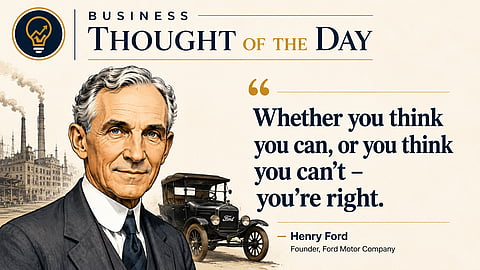

Success in business often begins long before a product is launched, a deal is signed, or an investment is secured. It starts in the mind. The way people think about themselves, their abilities, and their future can shape the outcomes they achieve. Few quotes capture this truth better than Henry Ford's famous observation: "Whether you think you can, or you think you can't – you're right."
At first glance, the quote appears simple. Yet it contains a powerful lesson about self-belief, attitude, and personal responsibility. Ford understood that confidence is not merely a pleasant feeling; it is often the foundation of achievement. People who believe they can solve a problem are more likely to persist when challenges arise. Those who convince themselves that success is impossible frequently give up before they have truly begun.
This lesson is particularly relevant in today's rapidly changing world. Entrepreneurs face intense competition, economic uncertainty, and constant technological disruption. Young professionals and Gen Z workers are entering a workplace transformed by artificial intelligence and digital innovation. In such an environment, talent alone is not enough. Adaptability, resilience, and confidence have become critical assets.
History is filled with examples of individuals who succeeded because they refused to accept limitations. Every breakthrough business, innovative product, or successful career began with someone who believed that a better future was possible. Confidence does not guarantee success, but a lack of confidence almost guarantees failure.
Henry Ford's own life demonstrates the power of this mindset. Born in 1863 on a farm in Michigan, USA, Ford showed an early fascination with machines. At a time when horses dominated transportation, the idea of affordable motor vehicles for ordinary people seemed unrealistic. Many experts believed automobiles would remain luxury items for the wealthy.
Ford thought differently. He envisioned a future in which cars were accessible to millions. In 1903, he founded the Ford Motor Company and pursued that vision relentlessly. His introduction of the moving assembly line revolutionised manufacturing, dramatically reducing production costs and making cars affordable for ordinary families. The Model T became one of the most influential products of the twentieth century, transforming transportation and helping shape modern industrial society.
Ford's achievements extended beyond automobiles. His manufacturing innovations influenced industries around the world and established principles that continue to guide production systems today. He demonstrated how a bold vision, combined with persistence and innovation, could change the course of history.
The deeper meaning of Ford's quote is not about blind optimism. It is about recognising the connection between belief and action. People who believe they can succeed are more likely to learn new skills, take calculated risks, seek opportunities, and persevere through setbacks. Their belief drives behaviour, and behaviour produces results.
The business lesson is clear: success begins with mindset. Markets fluctuate, competitors emerge, and obstacles are inevitable. But individuals and organisations that approach challenges with confidence and determination are far more likely to discover opportunities where others see only problems.
The next time a difficult challenge appears, remember Ford's words. Your greatest advantage may not be your resources, your experience, or your connections. It may simply be your willingness to believe that success is possible and then act accordingly.

